 EN
 FR
 DE
 NL
Sleeping in a rooftop tent inside the national parks, booking at the right moment, packing exactly what is missing: everything you need to know about camping in Namibia.
Why Namibia is a camping country
In Namibia, sleeping under canvas is not the budget fallback. It is the normal way to travel. Namibian campsites are among the best kept in Africa, they sit in places no lodge can reach, and the night sky above them is as clean as any on the continent.
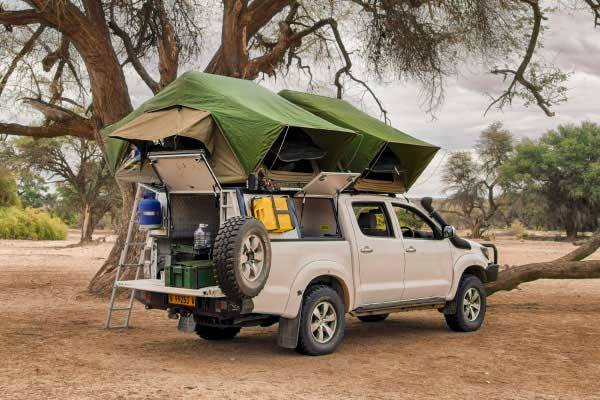
It is also one of the few countries where the rooftop tent is the standard rather than the exception. Almost every vehicle rented locally comes with one, along with mattresses, bedding and a full kitchen kit. You arrive, you fold the tent out, you sleep. That single fact is why a Namibia road trip built around camping costs a fraction of the same route done in lodges, and why most people who try camping in Namibia once never go back.
The three kinds of campsite
National park rest camps
Run by Namibia Wildlife Resorts, these are the rest camps at Etosha, Sesriem and the other national parks. They have one decisive advantage: sleeping inside the park puts you on the spot at the right hours. At Sesriem that is what lets you reach Sossusvlei at sunrise, ahead of everyone driving in from outside the gate. In Etosha, the rest camp waterholes are floodlit at night and watchable on foot from your pitch.
The trade-off: they cost more than private campsites, the ablutions are ageing in places, and they sell out months ahead in high season.
Private campsites
Usually set on farms or private reserves, and frequently the more pleasant option: widely spaced pitches, a private ablution block for each pitch (a Namibian speciality you will miss everywhere else), swimming pools, and a bar under a thorn tree. Private campsites in Namibia are cheaper than the park camps and there is almost always space.
Community concession campsites
In remote regions like Kaokoland and parts of Damaraland, you find very basic pitches run by local conservancies, sometimes without water or ablutions at all. This is the closest Namibia gets to wild camping, the money stays in the community, and it demands full self-sufficiency.
The best campsites in Namibia to plan the route around
Most itineraries are built backwards from a handful of campsites, because where you camp decides what you see the next morning. These are the ones that justify bending a route.
1. Sesriem Campsite, Sossusvlei
The only campsite inside the Sesriem gate, with camel thorn trees for shade and a swimming pool. Its entire value is the head start: you pass the inner gate at sunrise while day visitors are still queuing outside. Book this campsite first and build the rest of the trip around the date. The private camps just outside the gate are more comfortable but lose you the hour that matters.
2. Okaukuejo, Etosha
The most famous floodlit waterhole in Namibia, and the reason people put up with the crowds in the camp itself. Sit on the wall after dinner and elephant, giraffe and, with luck, black rhino come down to drink in near silence. Pitches near the waterhole are worth asking for.
3. Halali and Namutoni, Etosha
Halali sits in the middle of Etosha National Park with its own floodlit waterhole and a good swimming pool for the hot part of the day. Namutoni, at the eastern end, is built around a white German colonial fort. Splitting two nights between camps rather than staying put is what gets you across the pan properly.
4. Olifantsrus, western Etosha
A camping-only site with no chalets at all, and a two-storey hide built over the waterhole where you can sit at eye level with drinking elephant. Small, quiet and in the least-visited part of the park. If you only add one camp to a standard Etosha itinerary, make it this one.
5. Spitzkoppe Community Campsite
Pitches scattered among granite boulders at the foot of the Spitzkoppe massif, most of them with nothing but a long-drop and a fire ring. No lighting, no neighbours in sight, and a night sky that is the argument on its own. Bring all your water. Spitzkoppe is the campsite people describe when they get home.
6. Hoada Campsite, Damaraland
Community-run, with pitches built into the granite so that the boulders form the walls of your kitchen and your shower. There is a rock swimming pool. Hoada campsite is the standard overnight between Etosha and the coast, and the one most travellers name as their favourite campsite in the country.
7. Purros, Kaokoland
A conservancy campsite on the Hoarusib riverbed in the far north-west, where desert elephant move through between the trees. Basic, remote and reached on tracks that require a genuine 4x4 and a spare day. It is the reward at the end of the hardest driving in the country.
8. Hobas and Ai-Ais, Fish River Canyon
Hobas is the camp at the canyon viewpoints and the trailhead for the multi-day hike. Ai-Ais, at the southern end, has hot springs and a swimming pool, which after the drive south is not a small thing. Both make the far south worth the detour rather than a chore.
9. The coast: Swakopmund, Walvis Bay and Henties Bay
Camping on the coast is a different proposition: cold, foggy and windy, with campsites that are functional rather than beautiful. Swakopmund is where you do laundry, restock, eat properly and sleep with walls if you want to. Treat it as the resupply stop it is.
10. The Kalahari and the Quiver Tree Forest
On the south-eastern side, red dunes covered in tall grass with oryx and meerkats, and campsites cut into the dune crests. Near Keetmanshoop, the Quiver Tree Forest rest camp puts you inside the aloe forest for sunset. Both are natural first or last nights out of Windhoek.

When and how to book
Booking is the point that wrecks badly prepared trips. Booking for campsites inside the national parks runs roughly like this:
Six to nine months ahead for a July or August departure.
Three to four months for May, June, September or October.
A few weeks is enough in the rainy season.
Private campsites are booked far later, and many will take you without a booking outside the peak. The working rule: lock in Sesriem and Etosha first, build the itinerary around those dates, then fill the gaps with private campsites. Doing it the other way round is how people end up with a 500 km day they never intended.
Rooftop tent or ground tent
The rooftop tent dominates in Namibia, for three good reasons:
Set-up. Two minutes against twenty, which changes everything when you arrive at camp after five hours of gravel.
The ground. You are above the sand, the stones and the damp, on a proper mattress rather than a mat.
The wildlife. Jackals, warthogs and hyenas move through campsites at night. None of them is dangerous, but everyone sleeps better off the ground.
The ground tent keeps two advantages: you can leave camp standing and take the vehicle out for the day, and it uses less fuel over a long trip. For a first Namibia trip the rooftop tent is the obvious call.
Equipment: what comes with the vehicle, what to add
A vehicle rented for camping in Namibia normally arrives with the tent, mattresses, a table, chairs, a gas stove, crockery, a cool box or fridge and a water jerrycan. Check the exact inventory when you book, because it varies between agencies and the gaps are always the same ones.
A proper sleeping bag. Desert nights drop below 5 °C through the austral winter, June to August, and the blankets provided do not always cover it.
A head torch each. Campsites are not lit, and cooking one-handed with a phone gets old on night one.
Soft cool bags and food containers. The dust gets into everything that is not sealed.
Water beyond the jerrycan, particularly for the remote stages where the campsite may have none.
What camping in Namibia costs
Camping stays well below the cost of a lodge, and that gap is what makes a long trip through Namibia affordable at all. Rates are generally quoted per person per night, sometimes with a supplement per vehicle, and the national park camps sit above the private campsites.
Prices are revised regularly, so check with Namibia Wildlife Resorts for the park camps and with each establishment for the private ones rather than trusting a figure found online. Budget separately for park entry fees, which are charged per person per day on top of the pitch, and for firewood, which adds up over three weeks.
Seven rules for camping well in Namibia
Arrive before 4 pm. Making camp in the dark is miserable, and national park gates close at sunset with no flexibility whatsoever.
Leave nothing outside overnight. Shoes, food, bags: jackals and baboons take anything left on the ground.
Fill your water at every campsite. Some remote pitches have none at all.
Close the rooftop tent before driving out for a game drive. Wind damages it while you are away, and that comes off your deposit.
Buy braai wood in advance. It is not always available at the campsite itself.
Carry small notes in Namibian dollars. Some private campsites and most community sites do not take cards.
Check the gas at the depot and work out where you can refill it along the route before you leave Windhoek.
Frequently asked questions
Is it legal to camp anywhere in Namibia?
No. Wild camping is prohibited across almost the whole country, which is either private farmland or protected area. The network of organised campsites in Namibia is dense enough that it is never a real constraint.
Is Namibia safe for camping?
It is one of the safest camping destinations on the continent. The precautions are about wildlife rather than people: nothing left out, no walking around park rest camps after dark, and respect for the fences where they exist.
How much does it cost to camp in Namibia?
Rates are per person per night and vary by camp, with the national park camps costing noticeably more than private campsites. Park entry fees are charged separately, per person per day, and are easy to forget when budgeting.
Where can you camp in Namibia?
Inside the national parks at the Namibia Wildlife Resorts rest camps, on private farm and reserve campsites along every main route, and at community concession sites in the remote north-west. Between them they cover the whole country.
Do you have to book campsites in Namibia in advance?
For the national park camps, absolutely: six to nine months for July and August. For private campsites, a few days is usually enough outside high season.
Is there electricity on the pitches?
Often at private campsites, more rarely at the park camps, and never at community sites. A dual battery or a portable power station on the vehicle settles the question for the whole trip.
Can you camp in Namibia with children?
It has a strong reputation as a family destination for exactly this. Campsites are safe and spacious, many have swimming pools, and safari from the car suits children well. The long driving days remain the real constraint.
Can you rent camping gear, or must you bring your own?
The vehicle comes with the full camping kit, so there is nothing to hire separately. What you bring from home is the sleeping bag, the head torches and anything personal.
In short
Camping in Namibia is not a compromise, it is the best way to experience the country. Remember three things: book the national park camps early, bring a real sleeping bag for the cold desert nights, and arrive before 4 pm at every stage. For the full route, see our 15 day Namibia itinerary, and for what to build it around, things to do in Namibia.
