 EN
 FR
 DE
 NL
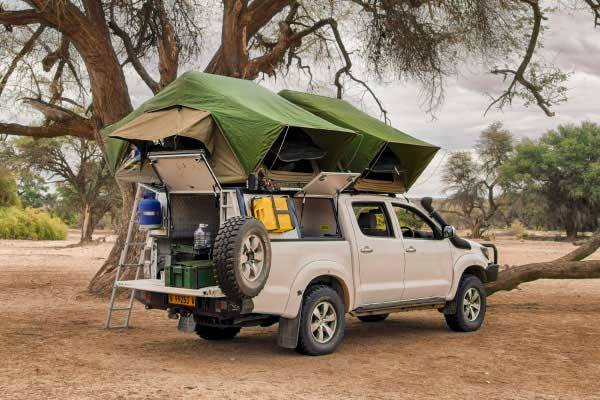
Red dunes, self-drive safari, a ghost town buried in sand and a coast made of shipwrecks: the 13 places that shape a Namibian trip, with how long to give each one.
A country where the sights have to be earned
Namibia does not work like a normal destination. The places worth seeing sit hundreds of kilometres apart on gravel, and a full driving day often separates two major sights. The useful question is not only what to see in Namibia, but how long to give each stop so the trip still holds together.
These are the thirteen places that shape almost every itinerary, from the unmissable to the genuinely quiet, with the time to allow for each.
The six essentials
1. Sossusvlei and Deadvlei
The red sand dunes of the Namib and the petrified trees of Deadvlei standing on white clay: this is the image of Namibia, and it delivers. Be at the park gate when it opens to climb Dune 45 or reach Deadvlei before the heat makes walking hard.
Allow: two nights at Sesriem, so you get one proper morning.
2. Etosha National Park
The safari here is done from your own vehicle, with no guide and no fixed hours. The method that works: park at a waterhole and wait. In the dry season elephants, zebra, giraffe, oryx, lions and occasionally black rhino all come down to drink.
Allow: three nights minimum, ideally at a camp inside the park where the waterholes are floodlit at night.
3. Damaraland
Raw rock landscapes, the UNESCO-listed rock engravings at Twyfelfontein, and the desert elephants that move up the dry riverbeds. This is the region that surprises travellers most, because they expect less of it than of the first two.
Allow: two nights.
4. Swakopmund and Walvis Bay
Swakopmund is the German colonial town wedged between desert and Atlantic: cafés, half-timbered architecture and ocean fog. It is also the resupply stop of the trip. Just south, the Walvis Bay lagoon holds thousands of flamingos, and it is the departure point for trips to Sandwich Harbour, where the dunes drop straight into the sea.
Allow: two nights.
5. The Skeleton Coast
The coast takes its name from the shipwrecks and whale bones left on the sand. Permanent fog, wind and no vegetation at all: the atmosphere is unlike anywhere else, more bleak than pretty. The Cape Cross seal colony, one of the largest in the world, is the standout stop.
Allow: one driving day with stops, crossing it.
6. Fish River Canyon
The second largest canyon in the world after the Colorado, in the far south. The viewpoints take a long drive to reach, which is why short itineraries usually skip it. The multi-day hike along the canyon floor books out well in advance.
Allow: one night, two if you walk.

Seven quieter places
7. Spitzkoppe
A granite massif rising straight out of the plain, nicknamed the Matterhorn of Namibia. You camp at the foot of the rocks, and the night sky is among the clearest on the continent. Easy to reach from the Swakopmund road, and still uncrowded.
8. Kolmanskop
A diamond-era mining town abandoned in the 1950s and slowly swallowed by the desert. The colonial houses with dunes pouring through their living rooms are a photographic subject with no equivalent. Permit-controlled access, near Lüderitz.
9. Kaokoland and the Himba
The wild north-west, hard to reach, home to Himba communities. This is genuine expedition travel: demanding tracks, full fuel and water autonomy required. Approach it respectfully and ideally with local guidance.
10. The Caprivi Strip
In the north-east, a corridor of land between Angola, Zambia and Botswana. Nothing like the rest of the country: rivers, dense vegetation and hippos. It is the natural gateway to Victoria Falls and the Okavango Delta.
11. The Kalahari
In the south-east, on the South African and Botswanan border, the Kalahari is not the bare sand desert people picture: it is semi-arid savannah with red sand dunes covered in tall grass, home to oryx, springbok and meerkats. Many travellers use it for their first or last night out of Windhoek.
12. The quiver tree forest
The aloes with their pale trunks form a forest near Keetmanshoop that turns unreal colours at sunset. A short stop, but a memorable one on the southern route.
13. Sesriem Canyon
A few kilometres from Sesriem camp, a narrow gorge cut into conglomerate that you can walk through. Perfect for late afternoon, when it is too hot for the dunes.
Lodges or campsites
Every site on this list offers both, and most travellers alternate. Namibian lodges are often outstanding, with spectacular settings on the edge of national parks, but they weigh heavily on the budget. Campsites are very well kept, far cheaper, and let you sleep inside the parks, which changes everything for early-morning wildlife watching.
The common compromise: camp inside the national parks to be on the spot at the right hours, and book one or two lodges for the stops where you want to breathe. Either way, a Namibian trip in high season books out months ahead. Our guide to camping in Namibia goes through the camps worth planning the route around and when each one has to be booked.
When to go
The dry season, May to October, is the reference period. Tracks are passable, skies are clear, and crucially the animals concentrate around Etosha's waterholes, which makes wildlife watching far easier.
The rainy season, November to April, gives green landscapes and almost no visitors, but dense vegetation makes animals harder to spot and some tracks become impassable. The Namib itself stays accessible year round.
Frequently asked questions
What can you do in Namibia in one week?
One week forces a choice. Either the desert (Sossusvlei, Swakopmund, Spitzkoppe) or the safari (Etosha and Damaraland). Attempting both means spending the week driving.
Which site is the most impressive?
Deadvlei wins on photography, Etosha on emotion. If you could only keep one it would be Sossusvlei, because nothing else looks like it anywhere.
Do you need a 4x4 to see these places?
For the six essentials, a high-clearance vehicle is technically enough. For Kaokoland, Sandwich Harbour and the sandy approaches, a genuine 4x4 is required.
Is Namibia good with children?
It has a strong reputation as a family destination: no malaria on most of the route, safari from the car, and very well-run campsites. The long driving days remain the real constraint.
How long do you need to see everything?
Three weeks covers all thirteen sites without rushing. Two weeks covers the essentials. Ten days means giving up either the south or the north.
In short
Namibia rewards travellers who accept seeing less but seeing it properly. Two nights per major stop, early mornings, and a deliberate decision to skip one or two sights: that is what turns a list of places into an actual journey.