 EN
 FR
 DE
 NL
The classic Namibia route in 15 days, stage by stage: real driving times, where to sleep, how many nights per site, plus the 10-day and 3-week variants.
Why 15 days is the right length
Fifteen days is what most travellers choose, and not by accident: it is the first length that lets you close the classic loop without spending your holiday behind the wheel. You keep two nights at each major stop, you can absorb a setback without wrecking the plan, and you come home rested.
A Namibia trip does not plan like a European one. Distances are enormous, fuel stations are rare, and driving days structure everything. This itinerary gives each stage with real driving times and the number of nights to allow.
10 days, 15 days or 3 weeks
10 days: the realistic minimum. Windhoek, Sossusvlei, Swakopmund, Etosha, back. Already dense, with several long driving days and no slack.
15 days (2 weeks): the sweet spot and by far the most common. The full classic loop with Damaraland and two nights per major stop.
3 weeks and more: room for Kaokoland, Fish River Canyon in the south, or the Caprivi Strip in the north-east.
Below ten days, drop Etosha or Sossusvlei rather than stringing together 500 km days. A good Namibia itinerary leaves room for the unexpected: a slower track than planned, an animal by the roadside, a campsite you do not want to leave.
The classic route: Windhoek, Sossusvlei, Swakopmund, Etosha
The loop most travellers follow, clockwise, with real driving times:
Windhoek to Sesriem (Sossusvlei): about 5 hours, mostly gravel. This is your first real gravel day, treat it as the learning curve.
Sossusvlei: two nights minimum. You need to be at the park gate when it opens to climb Dune 45 or reach Deadvlei before the heat.
Sesriem to Swakopmund: about 5 hours, through the Kuiseb canyon and the Namib. Swakopmund is the trip's civilisation stop: fuel, groceries, repairs, restaurants. Just south, Walvis Bay and its flamingo lagoon are worth the detour, and it is where Sandwich Harbour trips leave from.
Swakopmund to Damaraland: 4 to 5 hours. Twyfelfontein, desert elephants, raw rock landscapes.
Damaraland to Etosha: 4 to 6 hours depending on the gate. Allow three nights for the safari.
Etosha to Windhoek: about 5 hours, mostly tarred.
The Skeleton Coast slots in between Swakopmund and Damaraland for those who want the coast, but it adds significant distance and the landscape is bleaker than people expect.

Do you actually need a 4x4?
The honest answer: for the classic loop, a high-clearance vehicle is technically enough. Almost the entire circuit runs on well-graded gravel, with no water crossings and nothing technical.
But a 4x4 is still what most travellers take, for three reasons that have nothing to do with rock crawling:
Sand. Some campsite approaches, Sandwich Harbour and parts of Kaokoland need four-wheel drive and deflated tyres.
Durability. Over hundreds of kilometres of gravel, a real 4x4's suspension and tyres cope far better.
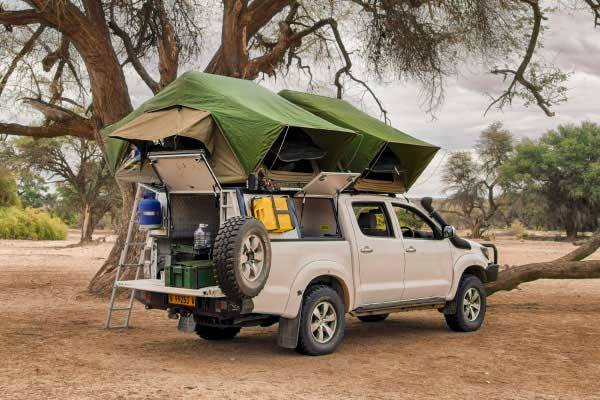
Equipment. Rooftop tent, dual battery, water tank, fridge: that is what makes camping possible, and it mounts on a 4x4, not a saloon.
Gravel roads: the real difficulty
Outside the few tarred trunk routes, Namibia runs on gravel. The C and D roads are generally well graded and deceptively fast, which is exactly the trap: gravel at speed is the leading cause of rollovers in the country, and it catches experienced drivers.
80 km/h maximum on gravel, even when the road looks perfect. Above that the vehicle floats and the smallest correction becomes uncontrollable.
No sudden inputs. Braking, steering, acceleration: all smooth. A sharp turn of the wheel on gravel sends the car sideways.
Slow down when passing another vehicle: flying stones break windscreens, the most common claim in the country.
Never drive at night. Wildlife crosses at dusk and dawn, and a kudu through the windscreen is a serious accident.
Count on a real average of 60 to 70 km/h on gravel including stops. That is the figure to plan with, not distance divided by 100.
When to go
The dry season, May to October, is the reference. Tracks are passable, skies are clear, and crucially the animals concentrate around Etosha's waterholes.
May and June: still green after the rains, mild temperatures, few people. Cold desert nights, bring a proper sleeping bag.
July and August: peak season. Optimal for wildlife, but campsites fill and prices rise. Book far ahead.
September and October: the best compromise for many. Wildlife highly concentrated, fewer visitors, but heat climbing sharply in October.
November to April: rainy season. Short intense downpours, some tracks cut, dense vegetation making animals harder to spot. In exchange, green landscapes and very few people.
Booking campsites: do not skip this
This is the classic mistake. Campsites inside the national parks, at Etosha and Sesriem in particular, fill up months ahead in high season. And sleeping inside the park changes everything: at Sesriem it is what lets you be at Sossusvlei for sunrise, before the buses arrive from outside.
This is not a country to improvise park accommodation in. Outside the parks, private campsites are plentiful and there is almost always space.
Frequently asked questions
Do you need an international driving permit?
Your national licence is enough if it is in English or comes with a translation. The international permit is cheap and avoids any discussion at the rental desk or a police stop: take it.
Do they drive on the left in Namibia?
Yes, on the left, as in South Africa. On empty gravel you forget quickly; the care is needed at junctions and leaving fuel stations.
Can you do Namibia in a normal motorhome?
The tarred routes allow it, but a long, low vehicle handles gravel and some campsite approaches badly. The rooftop-tent 4x4 remains the coherent choice for the full loop.
Is wild camping allowed?
No, unlike some other destinations. Almost all the land is private farms or protected areas. You sleep at established campsites, which are numerous and often superb.
Is there phone signal on the road?
In towns and on the main routes, yes. On gravel and in remote areas, no. Download offline maps and tell someone your route.
In short
A Namibia itinerary needs little technique and a lot of preparation. Three things to remember: allow 15 days to do the loop without rushing, drive at 80 km/h maximum on gravel, and book your park campsites well before you leave, which our guide to camping in Namibia covers camp by camp. The country handles the rest. For the full list of places, see things to do in Namibia.
