 EN
 FR
 DE
 NL
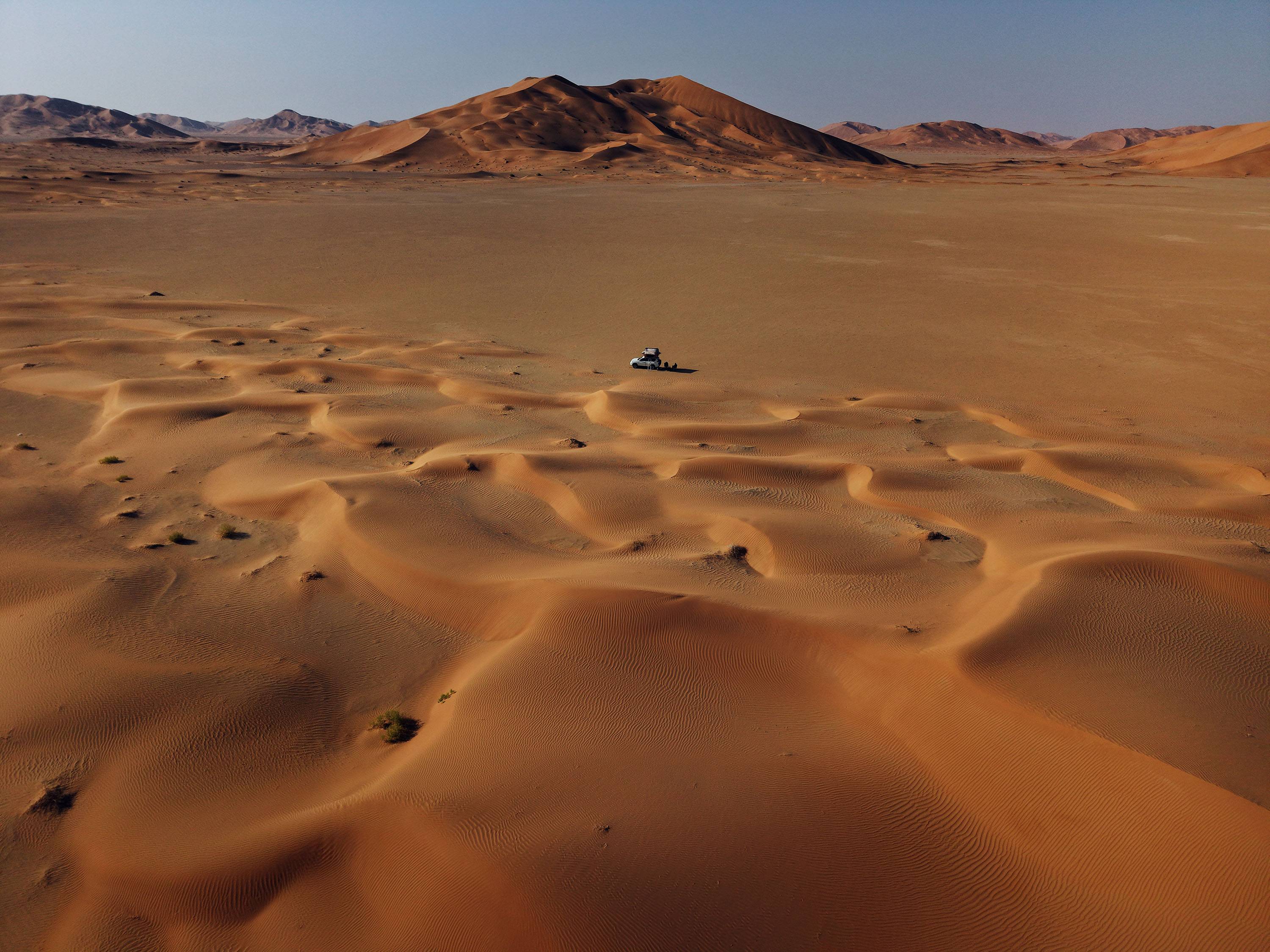
Deflating tyres, reading a dune, picking a camp spot and digging yourself out: what you need to know before driving into the Oman desert.
Two deserts, two very different trips
Oman has two sand landscapes, and confusing them ruins itineraries.
The Wahiba Sands (officially Sharqiya Sands), three hours from Muscat: a sea of orange dunes 180 km long and 80 wide, with established camps and a marked way in. This is the accessible desert, and where 95% of visitors go.
The Rub al-Khali, the Empty Quarter, in the south: the largest sand desert on earth. That is expedition territory, with two-vehicle convoys, GPS navigation and full water and fuel autonomy.
This guide covers the Wahiba Sands.
Deflating your tyres: the one thing that matters
This is the single essential step, and the one visitors skip most often. Lowering the pressure lengthens the tyre's contact patch and spreads the vehicle's weight over a much wider area, so it floats on the sand instead of digging in.
18 psi (about 1.2 bar) is the reference figure for Wahiba sand.
Drop to 12 psi only if you get stuck anyway, then drive very gently.
Reinflate before returning to tarmac. Driving deflated on asphalt destroys sidewalls and can pop a tyre off the rim.
Carry a portable compressor, or confirm your camp lends one. There are inflation points at the main track exits, but they cannot be relied on.


Driving on sand: the rules
Keep your momentum. On sand, speed is your friend: slowing down on a climb means stopping, and stopping means getting stuck.
No sudden inputs. Steering, braking and acceleration all happen smoothly, or you dig in and slew sideways.
Take dunes straight on, never at an angle. The risk of a lateral roll is real.
Never crest a ridge blind. The far side can be a sand cliff. Stop and walk up to look first.
Follow existing tracks where they exist: the sand there is already compacted.
Drive early or late. Sand is firmer in the morning, and low light reveals the relief that is invisible at midday.
If you get stuck
It happens to everyone, and it is not a problem if you react properly.
Stop accelerating immediately. Every extra wheel rotation digs you deeper.
Clear the sand in front of and behind all four wheels, and from under the chassis if it is grounded.
Drop the pressure further, to around 12 psi.
Place recovery boards under the driven wheels, or floor mats if you have nothing else.
Reverse out along your own tracks, gently. It is almost always easier than going forward.
Wild camping in the desert
Oman is one of the few countries where wild camping is free and legal, outside private property. In the Wahiba that means you can pitch a tent or open a rooftop tent wherever you like.
How to pick a spot:
On a ridge or raised flat, for the view and to avoid the bottom of a bowl, which is colder at night.
Never in a wadi bed, however dry it looks. A flash flood can arrive within minutes of a storm tens of kilometres away.
Out of the wind, behind a dune, because blown sand gets into everything.
Arrive before sunset so you can scout the ground and set up in daylight.
If wild camping feels like a step too far, the established desert camps are a comfortable middle ground: Bedouin-style tents, meals, and usually help with the 4x4 approach.
When to go
October to April, without hesitation. In summer the temperature passes 45 °C and the desert becomes genuinely dangerous, not merely unpleasant. December to February gives the most comfortable days, at the cost of properly cold nights.
What to bring
Water: 4 litres per person per day, plus a reserve.
Recovery boards and a shovel.
A compressor to reinflate, and a pressure gauge.
A tow strap and shackles.
Offline maps and a power bank: there is no signal deep in the dunes.
Sun protection, a scarf and glasses against blown sand.
Frequently asked questions
Can you enter the Wahiba Sands without a guide?
Yes, access is open. The first few kilometres from Al Wasil are marked and busy. Beyond that, experience or local support is advisable.
What tyre pressure for the Oman desert?
18 psi (1.2 bar) is the reference for Wahiba sand. Drop to 12 psi only if you get stuck, and reinflate before returning to tarmac.
Is wild camping allowed in the desert?
Yes, freely and at no cost outside private property. It is one of the great freedoms of travelling in Oman.
Is there phone signal in the desert?
At the edges yes, deep in the dunes no. Download offline maps and tell someone your route.
Is the desert suitable for families?
Very much so, staying on the established approaches and in camps. Children love the dunes. Just avoid long crossings and technical ridges.
In short
The Oman desert is surprisingly accessible provided you respect three rules: deflate to 18 psi, keep your momentum, and never camp in a wadi bed. To place the desert inside a full route, see what to do in Oman or our Oman self-drive hub.

