 EN
 FR
 DE
 NL
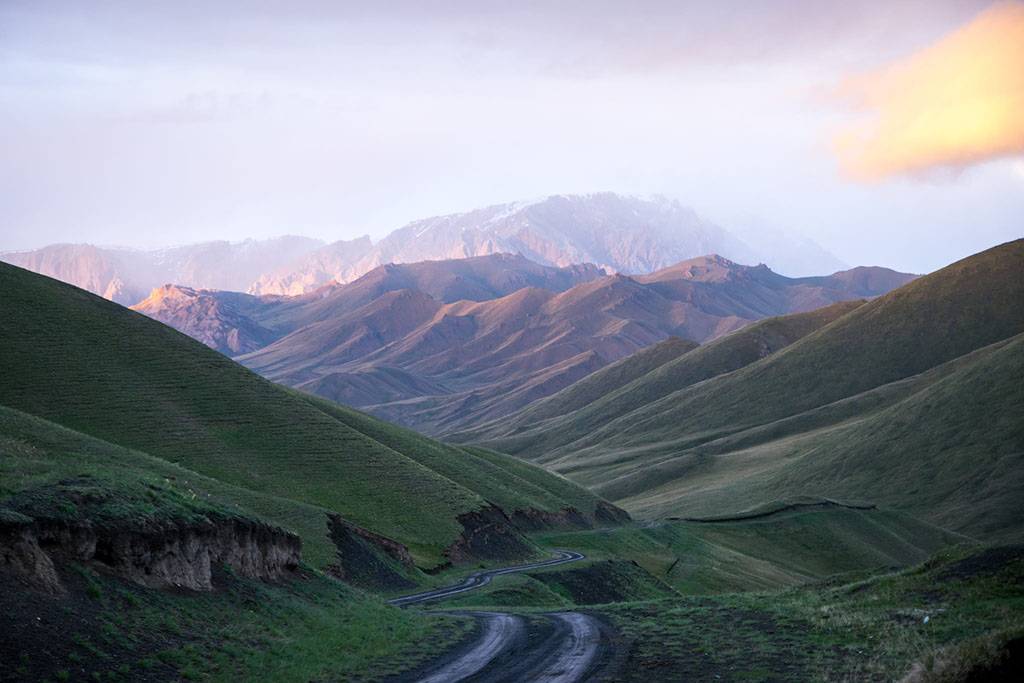
Three routes that work, depending on how much time you have: the northern loop in one week, the grand tour in two, and the full crossing to Osh and the Pamir in three.
How to build a Kyrgyzstan itinerary
Three constraints govern every Kyrgyzstan itinerary, and getting them wrong is what turns a trip into a driving marathon. First the season: the high passes and the yurt camps are only open from mid-June to mid-September. Second the road times: on a mountain track the real average is around 40 km/h including stops, which is half what the map suggests. Third the permits: some border zones need a document applied for weeks ahead.
Work from those three and the country arranges itself into three clean routes. What follows is the one-week northern loop, the two-week grand tour, and the three-week crossing to the Pamir, each with the hikes worth stopping for along the way.
7 day itinerary: the northern loop
The shortest format that makes sense. It stays in the north of the country and avoids the long transitions south, which is exactly what a week can absorb.
Day 1: arrive in Bishkek, collect the vehicle, night in the city. Walk Osh Bazaar in the afternoon and buy what the trip turns out to need, because the choice thins out fast once you leave Bishkek.
Day 2: Bishkek to the south shore of Issyk Kul, stopping at Burana Tower and its field of stone grave markers. Night at Bokonbayevo or Tamga. Bokonbayevo is where eagle hunting demonstrations are given, and it is worth timing the afternoon around one.
Day 3: Skazka Canyon in the morning, an hour of eroded red rock straight off the Issyk Kul lake road, then Jeti Oguz and its Seven Bulls gorge. Night in Karakol.
Day 4: the Karakol day. Either the rough climb into Altyn Arashan for the hot springs, or a hike in the Jyrgalan valley, depending on how much walking you want. Both are alpine meadow, spruce and snow-capped peaks at the top.
Days 5 and 6: down to Kochkor, then up to Song Kul over the Kalmak Ashuu mountain pass. Two nights in a yurt camp on the shore of this alpine lake at 3,016 metres above sea level, with horses available on the spot and no phone signal at all.
Day 7: back to Bishkek and drop the vehicle. If the flight is late, Ala Archa National Park is forty minutes from the airport and makes a far better last morning than the city.
Distance: roughly 1,200 km on the road. Vehicle: a 4x4 is required for the climb to Song Kul, whichever pass you take.
2 week Kyrgyzstan itinerary: the grand tour
This is the best-balanced format and the one most travellers end up choosing. Two weeks in Kyrgyzstan adds the Naryn region, Tash Rabat and the big passes, and it lets you cross the whole country rather than loop back on yourself.
Days 1 to 4: identical to the northern loop above, as far as Karakol and its valleys. Take the Ala Kul trek here if you have the legs for it: a three day trek over a pass close to 3,900 metres, finishing at the Altyn Arashan hot springs.
Day 5: the Barskoon valley and its waterfall, then the climb onto the high plateaus, or the direct road to Naryn if the weather has closed the tops.
Day 6: Naryn, then Tash Rabat. Night in a yurt beside the fifteenth-century Silk Road caravanserai at 3,200 metres, which is the quietest place on the whole route.
Day 7: Kel Suu if your permit came through, back towards Naryn if it did not. This is the one day of the itinerary that hinges on paperwork.
Days 8 and 9: Song Kul over the Moldo Ashuu pass from the Naryn side, which is the finest of the four approaches. Two nights on the plateau.
Day 10: down to Kochkor and across to the Suusamyr valley, a wide green basin full of summer yurts and almost no traffic.
Days 11 and 12: the Ala Bel and Too Ashuu passes, both above 3,000 metres, then the long descent towards Osh through the edge of the Fergana valley.
Day 13: Osh, the Jayma bazaar and Sulaiman Too, the sacred mountain that rises straight out of the town.
Day 14: domestic flight Osh to Bishkek, or drop the vehicle in Osh.
Distance: roughly 2,000 km. Worth checking: many agencies charge a one-way drop fee between Bishkek and Osh. Confirm it at the time of booking, because it is rarely quoted up front and it changes the comparison between agencies.
21 day itinerary: south to the Pamir
Three weeks buys the deep south and, for the more adventurous, the crossing into Tajikistan. It is also the only version of this trip where you stop counting driving days.
Days 1 to 14: the grand tour above, taken without rushing, which mostly means an extra night at Song Kul and a real trek near Karakol.
Days 15 and 16: Arslanbob and the largest walnut forest in the world, with a waterfall above the village, then Sary Chelek and its forested alpine lake inside a UNESCO biosphere reserve.
Days 17 and 18: the Alay valley from Osh, as far as Sary Tash, which sits on an open plain facing the wall of Lenin Peak. There is nothing subtle about the view and nothing much else in the village.
Days 19 to 21: return north, or cross into Tajikistan over the Kyzyl Art pass to join the Pamir Highway.
The Tajik crossing needs a Tajik visa, a GBAO permit and the rental agency's written agreement to take the vehicle over the border. Declare it when you book, not when you collect: agencies that allow it are a minority, and the ones that do not will refuse at the desk.
Which direction to go round
Clockwise, starting with Issyk Kul, has two advantages. It puts the easiest driving days first, which gives you time to work out how the roads behave before anything difficult. And it places Song Kul in the middle of the trip, by which point you are acclimatised both to the altitude and to the local style of driving.
The other direction earns its place if you are starting from Osh, or if you are travelling in August and want to hit the southern shore of Issyk Kul before the domestic holiday crowd rather than after it.
Where you will actually sleep
Accommodation on this route falls into three kinds, and knowing which is which saves a lot of pointless booking.
Guesthouses in Bishkek, Karakol, Naryn and Osh. Family-run, cheap, breakfast included, and almost always available on the day. Karakol in August is the one exception worth booking ahead.
Yurt camps at Song Kul, Tash Rabat and on the jailoo. Some are commercial and take bookings; many are simply herding families who take guests. Dinner and breakfast are included, there is no electricity to speak of, and it gets genuinely cold at night even in July. A yurt camp is where the nomadic culture of the country stops being an abstraction.
Your own vehicle, wherever you stop. Wild camping is tolerated across most of the country outside protected areas, and in remote areas on the plateaus it is often the better option.
Best time to visit Kyrgyzstan
The useful window is mid-June to mid-September, and it is narrower than most people expect. Before mid-June the high passes still hold snow, the tracks are mud, and the yurts have not gone up. After mid-September the herders come down and the plateaus close for the year.
Inside that window, July and August give the warmest nights, the full jailoo in operation and the busiest guesthouses. Late June and early September are quieter and clearer, but the nights at Song Kul are cold and a pass can close for a day after fresh snow. If you have a choice, the first half of September is the best time to visit Kyrgyzstan on the whole calendar.
How to get to Kyrgyzstan and get around
Almost everyone flies into Manas airport outside Bishkek, connecting through Istanbul or the Gulf hubs. Flying home from Osh is what makes the two-week itinerary work as a crossing rather than a loop, and the domestic hop back to Bishkek takes about an hour.
Between towns, the country runs on shared taxis and marshrutka minibuses. A shared taxi is cheap, leaves when full, and will get you from Bishkek to Karakol, Naryn or Osh with no planning at all. What a taxi will not do is take you onto the jailoo. Song Kul, Kel Suu, Altyn Arashan and Tash Rabat have tracks rather than roads, and no scheduled transport goes near them.
That is the practical fork in this itinerary. Public transport plus hired drivers for the mountain sections works and is what most backpackers do. Your own vehicle costs more but removes the negotiation from every single day, which on a two-week route through Central Asia is worth a great deal.
What to know about driving
Plan at 40 km/h on mountain tracks, stops included. Use that figure rather than the distance on the map, and the itinerary stops falling apart on day three.
Fill up whenever you can. Between Kochkor and Naryn, or between Sary Tash and the border, stations vanish for hundreds of kilometres.
Download offline maps. Mobile coverage stops as soon as you leave the main valleys, and it does not come back until the next town.
Carry cash in som. Cards work in Bishkek, Karakol and Osh, and nowhere else that matters.
Do not drive tracks at night. Livestock on the road, no lighting and potholes you cannot see are a bad combination at altitude.
Is Kyrgyzstan safe?
Yes, and by a comfortable margin: Kyrgyzstan is among the safest countries in Central Asia for independent travel, including for solo women and for camping in remote areas. Petty theft exists in the Bishkek and Osh bazaars at the same level as any large city, and that is about the extent of it.
The genuine risks on this itinerary are environmental rather than human. Altitude sickness at Song Kul and Tash Rabat, mountain weather that turns in an hour, river crossings that rise through the afternoon as the glaciers melt, and tracks with long exposed drops and no barrier. None of these is a reason not to go; all of them are a reason to start early and stop early.
Frequently asked questions
How many days do you need in Kyrgyzstan?
Seven days covers the northern loop with a night at Song Kul. Below that, concentrate on Issyk Kul and Ala Archa National Park rather than attempting the high plateaus, because a rushed drive up a mountain pass is the one way to waste a short trip here.
Is two weeks enough for Kyrgyzstan?
Two weeks in Kyrgyzstan is the right length for a first trip. It crosses the country from Bishkek to Osh, includes Song Kul and Tash Rabat, and still leaves room for one proper trek.
Can you do Bishkek to Osh one way?
Yes. Several agencies allow it for a drop fee, and the domestic flight brings you back to Bishkek in an hour. It is what saves you 600 km of driving the same road twice.
Do you need a border permit for these routes?
Only if you include Kel Suu, Torugart or Lenin Peak. The 7 and 14 day itineraries above work without any permit if you leave Kel Suu out.
Do you need to book accommodation in advance?
Rarely, other than Karakol in August. Yurt camps on the jailoo are arranged by turning up, and town guesthouses almost always have space.
Can you do this itinerary without a 4x4?
Partly. The tarmac sections are fine in any car, but Song Kul, Kel Suu and Altyn Arashan are not, and those are the days people remember. The usual workaround is a normal car plus a hired driver for the mountain legs.
In short
A Kyrgyzstan itinerary that works comes down to three decisions: travel between mid-June and mid-September, plan at 40 km/h on tracks rather than 80, and apply for the border permit early if Kel Suu is on your list. For the full list of places to build a route around, see things to do in Kyrgyzstan.

